

Lost-Wax Bronze Casting Process
Geoffrey utilizes the timeless lost-wax bronze casting process, traditionally known as cire perdue, to transform his original clay works into enduring masterworks. Dating back to the 3rd millennium BC and refined across Europe over centuries, this intricate, multi-stage fine art investment casting method remains the gold standard for producing museum-grade bronze sculptures. While the journey from raw clay to molten metal is notoriously slow and meticulous, it is arguably the only method capable of preserving the absolute highest level of detail, texture, and artistic intent.
Step inside the studio workflow to see exactly how Geoffrey's original clay sculptures are transformed, step-by-step, through the fires of the fine-art bronze foundry.

Making A Mold
The creation of a museum-quality bronze sculpture begins with a highly detailed silicone rubber mold. The artisan meticulously brushes a specialized liquid rubber directly onto the surface of the original clay work. This captures every subtle gesture, fingerprint, and tool mark left behind by the sculptor. Once the flexible rubber inner mold cures, a rigid outer plaster framework known as the "mother mold" is built over it by hand to prevent distortion. When separated, this combined mold yields a flawless negative impression of the original sculpture.

Making a Wax Model
Once the negative mold is prepared, melted structural wax is carefully poured inside. The artisan rotates and swishes the liquid wax across the interior surface to form a perfectly uniform coating. This cooling process is repeated through multiple layers until the wax model reaches the exact desired thickness of the final bronze wall. After cooling completely, the fragile, hollow wax sculpture replica is extracted from the mold. Because the master mold remains fully intact, it is preserved for future limited-edition archival castings.
Chasing & Spruing
The raw wax replica now enters wax chasing, an intensive refining stage where blemishes, mold seams, and air bubbles are carefully melted, smoothed, and resculpted by hand. Once the wax copy matches the flawless standard of the original clay, a complex network of wax channels—called sprues, gates, and a pouring cup—is structurally welded onto the figure. This intricate, tree-like plumbing system serves a vital dual purpose in the foundry process: it creates pathways for the molten metal to flow smoothly and allows trapped gases to escape seamlessly.

Ceramic Shell
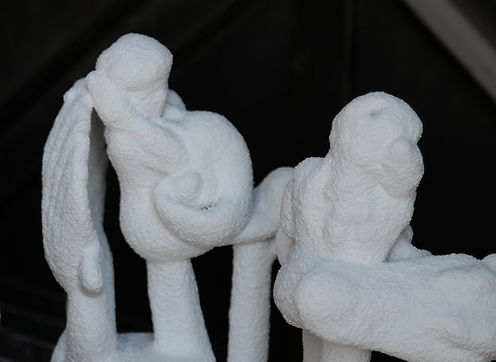
Once the wax model is complete, it is dipped in a liquid ceramic mixture, then covered in fine sand. When this first coat is dried these steps are completed until the desired thickness is obtained. Now there is a ceramic mold with the wax model still inside.
Lost Wax Process
After the ceramic shell is finished, it is placed into a furnace to cure. During this step, the wax model melts out, and we are left with the ceramic shell, which includes the sprues and cup. This is where the name "lost wax" originated. Since each sculpture has to have a wax model, and each time a bronze is poured, the wax is lost when melted away.


Pouring the Bronze
The empty ceramic shell is now filled with molten bronze. The bronze, around 2100 degrees Fahrenheit, is poured into the cup and flows through the "sprues" into the negative space.
Breaking The Mold to Reveal the Sculpture
After the bronze has cooled, the ceramic shell is broken away, revealing the raw bronze sculpture. Often cast in small pieces, the sculpture looks like a puzzle. Additionally, the no longer needed metal channels must be removed by a fine-art welder. The sculpture you see here is Stainless Steel! Cast in a very similar process.


Bringing it all together with Fine Art Welding.
Following the removal of the ceramic shell, the raw, rough bronze elements are revealed. Because complex or monumental sculptures are often cast in multiple separate pieces, they must be meticulously reconstructed using precision fine art welding. Once structurally joined, the sculpture undergoes intensive metal chasing and sandblasting. The artisan carefully grinds down weld lines and resculpts the metal surfaces to flawlessly match the texture and detail of the original clay masterwork. This execution is performed with such exacting precision that the final piece appears entirely seamless, masking any evidence of the intricate puzzle beneath.

Patina
The last step before the sculpture is ready for its new home is the patina process. This is where the color is achieved. By heating the bronze and applying different combinations of chemicals, acids, and pigments, many different color variations can be achieved. Once the patina is finished, a layer of wax is applied to the sculpture for protection.